
You don't need more consultants. You need a strategy for capability.
Governments keep renting other people's learning and calling it transformation. The piece argues that capability sticks when an executive owns the mandate long enough for it to compound, and when knowledge transfer gets treated as a contracted deliverable instead of a courtesy.
 Nicholas Scott
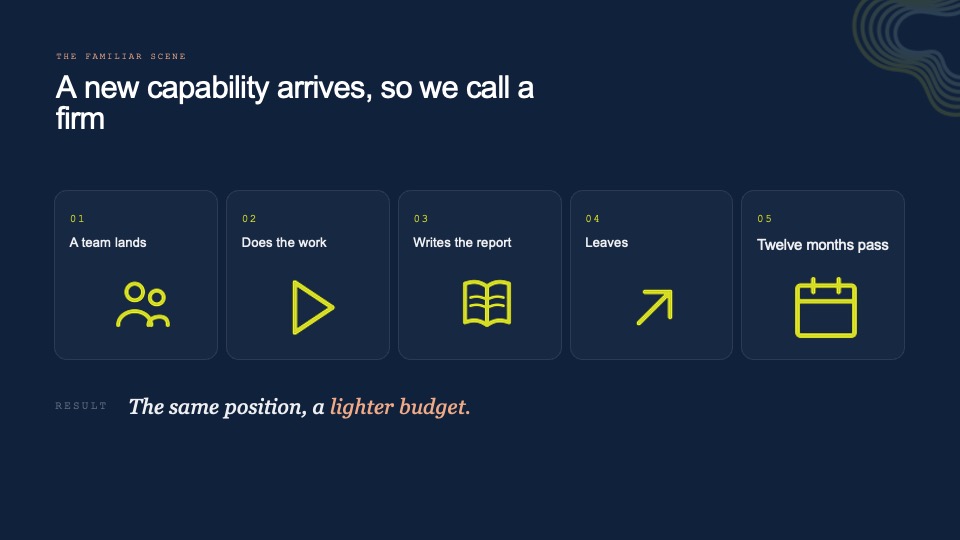
There's a familiar scene in government transformation work. A new capability arrives like service design, product management, data science, futures thinking, or AI ethics, and the first instinct is to call a consulting firm. A team lands, does the work, writes the report, and leaves. Twelve months later, the organization sits in the same position with a lighter budget. Worse: some public organizations bring consultants in to fill routine, operationally defined roles.
I am not saying "don't use consultants." I mean, honestly, I work as one! The criticism lands on how governments use us. The question of whether to use us at all is settled.
Bringing in external expertise makes sense when a capability is genuinely novel and no internal roles exist for it. The problem is we bring it in without a plan for what comes after. We often procure capacity when we need capability. Those are different things.
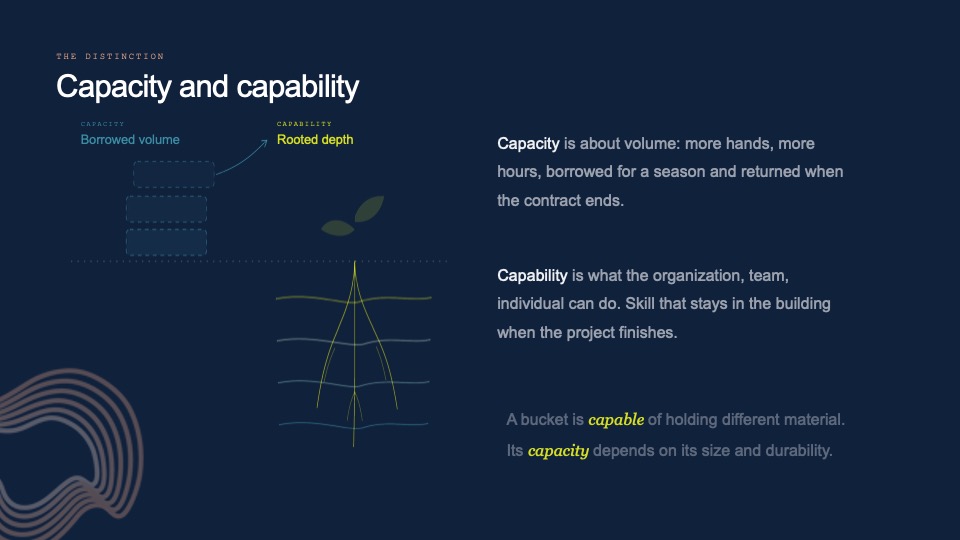
Capacity is about volume. Capability is what an organization can do on its own. A bucket is capable of holding all types of materials. Its capacity depends on its size and durability.
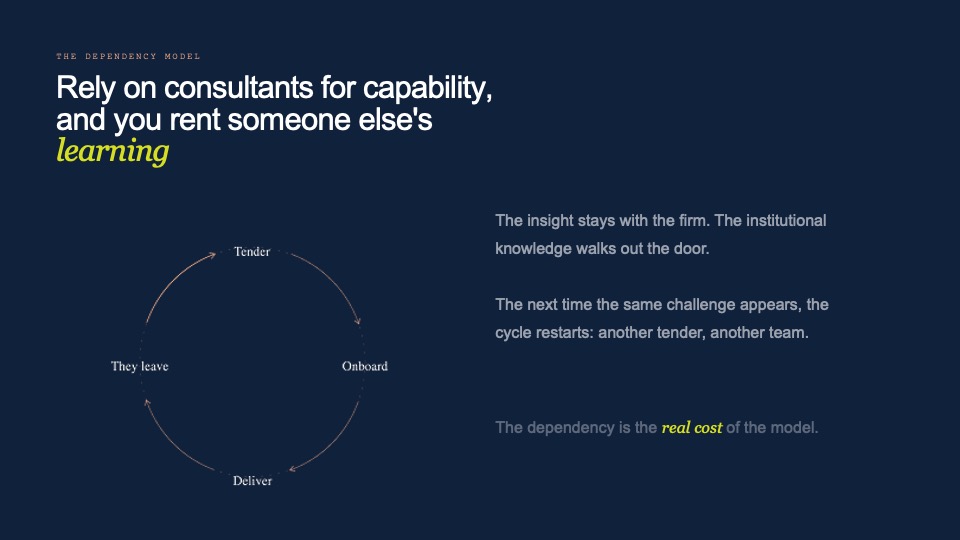
When governments rely on consultants to fill a capability gap, they rent someone else's learning. The insight stays with the firm. The institutional knowledge walks out the door. The next time the same challenge appears, the cycle restarts: another tender, another onboarding, another team. The dependency is the real cost of the model.
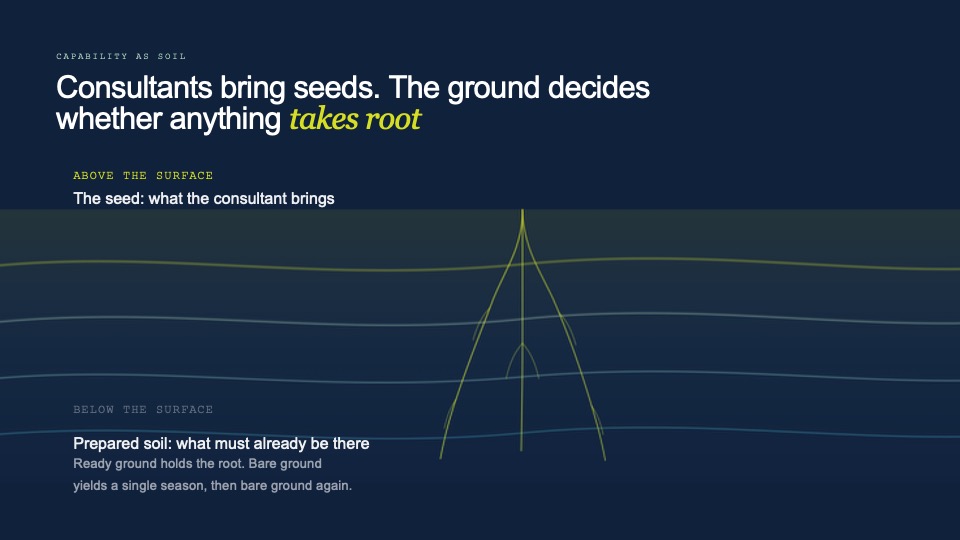
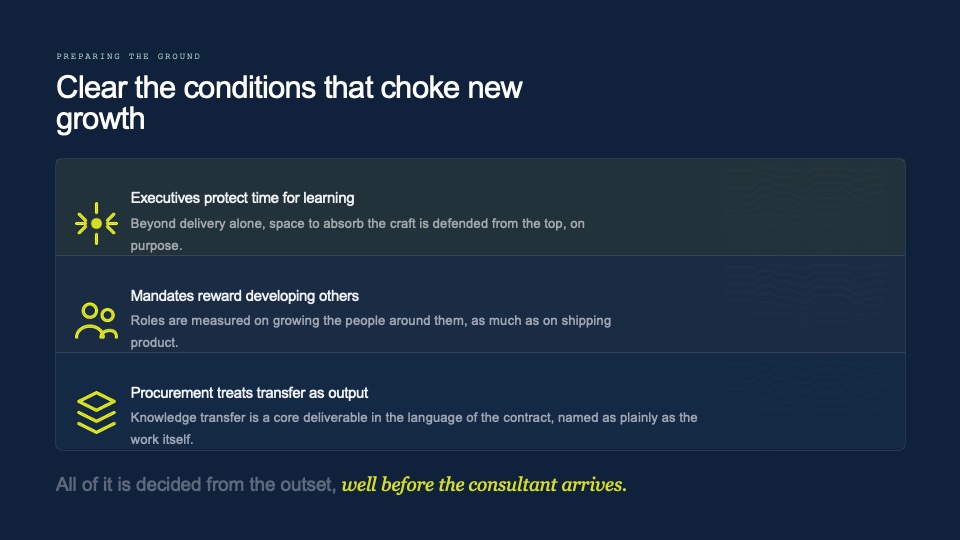
Think of organizational capability like soil. Consultants can bring seeds, plant them, water them for a season. But if the soil isn't prepared first, nothing takes root. Preparing the soil means something specific: clearing the conditions that choke new growth. Executives protect time for learning alongside delivery. Role mandates reward people for developing others alongside shipping product. Procurement language treats knowledge transfer as a core output. None of that happens by accident. None of it happens after the consultant arrives. The organization decides it from the outset.
Building capability means creating the conditions for new skills, new roles, and new ways of working to become native to the organization. The question governments should be asking is who inside the organization is responsible for making sure the learning stays.
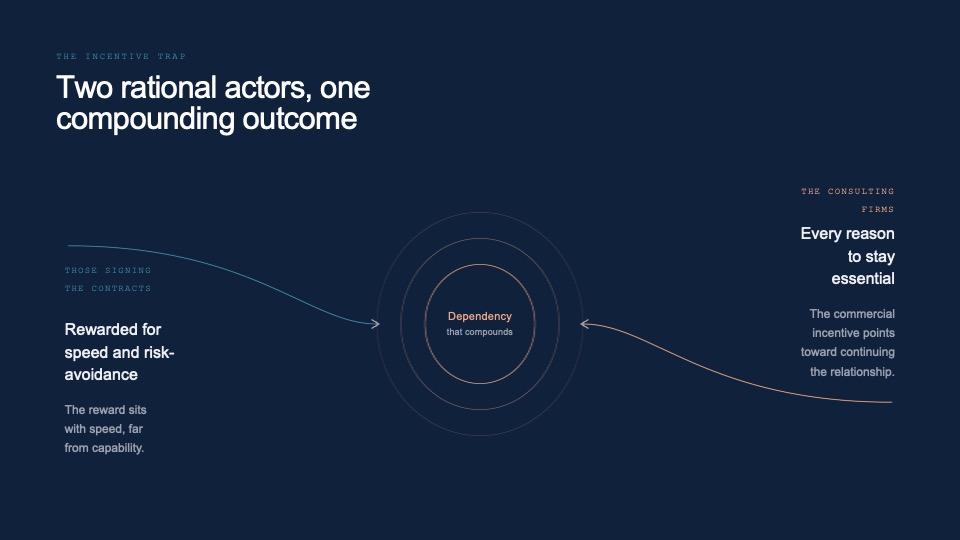
Here is where it gets harder. The real obstacle lies with the incentive structure around the people signing procurement contracts. The system rewards them for speed and risk-avoidance, and capability-building sits outside that. Consulting firms have no commercial incentive to make themselves unnecessary. Both sides behave entirely rationally and still produce the same outcome: dependency that compounds with every contract.
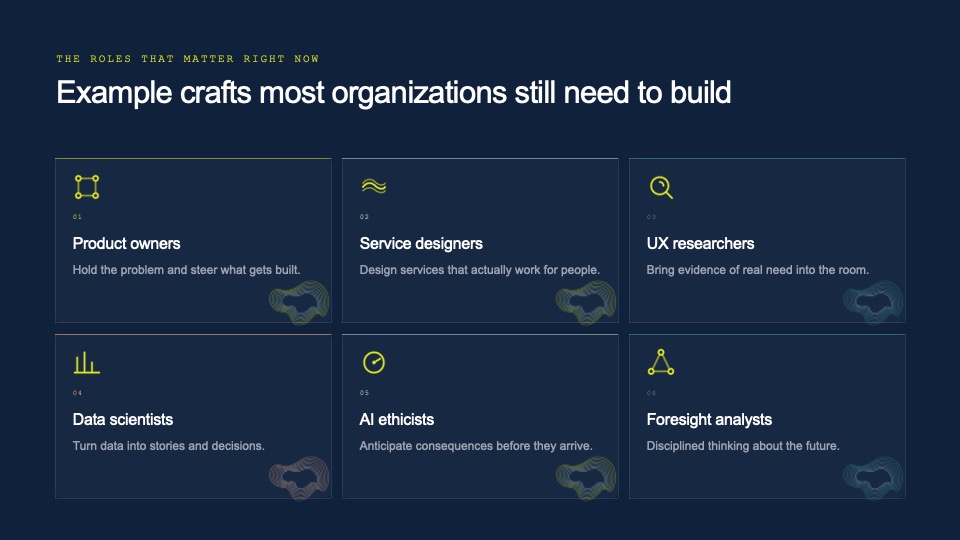
A specific set of roles matters most right now. Product owners. Service designers. UX researchers. Data scientists. AI ethicists. Foresight analysts. These are the people who help governments design services that work, anticipate consequences, and build technology that serves people. Most government organizations lack these roles entirely. Some have created the titles and called it done. Others have contracted the work out, which keeps the capability permanently external.
This is a structural problem. Procurement cycles alone will not fix it.
A smarter approach has a clear theory of change. The consultant works alongside someone internal who is learning the craft too. The contract names knowledge transfer as a deliverable from day one. A brief that asks for a service design engagement differs from a brief that asks for a service design engagement that leaves behind a trained internal practitioner (or practitioners) and a documented methodology the organization can use again. Both cost roughly the same. Only one builds anything that lasts.
In my experience, knowledge transfer gets quietly dropped the moment a project hits pressure. Delivery deadlines win. The learning slips. A contract clause cannot hold the line on its own. It needs a named person inside the organization with the mandate, the protected time, and the standing to hold the line when pressure mounts. Not a working group. Not a shared responsibility. One person, with budget authority and a multi-year horizon, whose performance measures track capability growth alongside project throughput. And before the next contract is signed, there should be a clear answer to whether the transfer actually happened in the last one.
This is where most capability strategies fall over. The authority to hold the line ends up unassigned, scattered across half-owned roles and good intentions.
An internal capability team can work when the organization genuinely resources it: a small group of skilled practitioners who deploy into line departments, develop staff alongside delivery work, and actively distribute what they know. Over time, departments build their own fluency. But I have watched that unit get stood up and hollowed out within a year. Three people with no budget authority get steamrolled the moment a programme director decides they prefer the status quo. A unit resourced only for delivery will always default to delivery. The team only works if it reports to someone with enough seniority to say no to that programme director, and enough political cover to absorb the cost of saying it.
That is the uncomfortable truth this kind of strategy tends to avoid. A team alone cannot make capability stick. An executive who owns the mandate long enough for it to compound makes it stick, and who is willing to slow down delivery when the alternative is hollowing out the learning. Most organizations have not named that person. Most have not asked who should bear that cost.
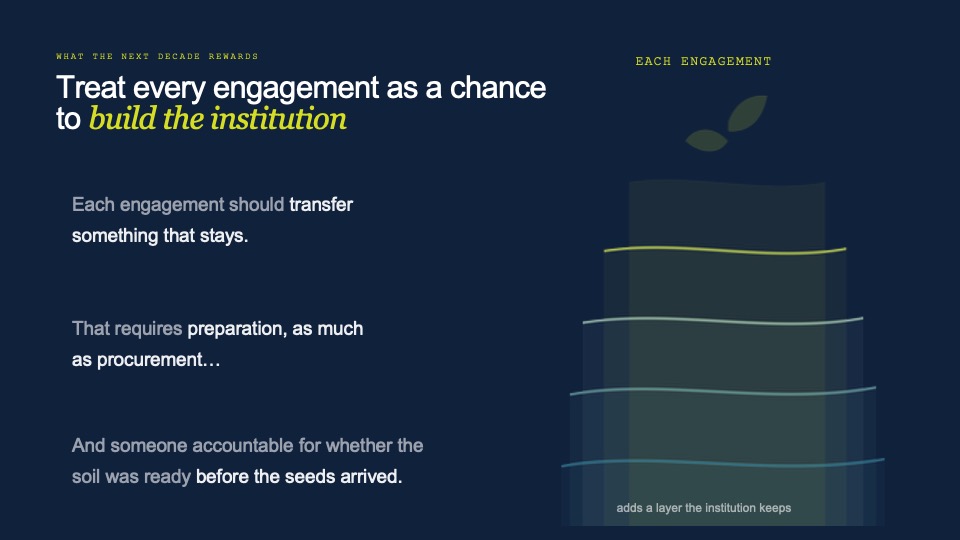
The organizations that will build real capability in the next decade treat every external engagement as a learning opportunity for the institution. Each engagement should transfer something that stays. That requires preparation alongside procurement. And it requires someone, specifically, to be accountable for whether the soil was ready before the seeds arrived.
The work begins in earnest when the consultant leaves. But only if someone was already tending the ground.